Thursday, December 22, 2011

Piz Languard

Location: Pontresina, Upper Engadine, Canton Graubünden

Distance: 5km /3.1 miles one way

Duration: 3-4 hours

Piz Languard, at 3262 meters / 10702 feet is one of the great lookouts of the Engadine with views that stretch to the Monte Rosa on the east and even to Zugspitze in Germany to the far north. It’s a popular dayhike from Pontresina and is most frequently combined with a chairlift ascent and a lunch at Chamanna Georgy, all of which contribute to the fun and take advantage of the nonstop views.

For a fast start, go to the Alp Languard chairlift station in the center of Pontresina. Taking the lift will cut a full hour of ascent from the hike and take you to a starting point above the timberline. Make the ascent on foot, walk to the church of Santa Maria with its 12th century tower, and follow the signposted trail from there.

Alp Languard, where the chairlift tops out, is a popular summer destination with a restaurant and grassy slopes for picnicking and restfully enjoying the views of Piz Palü. It’s also an excellent junction for other hikes in all directions.

From Alp Languard you’ll recognize Piz Languard as the broad pyramidal peak to the east. One of the highlights of this walk—indeed, of most walks in the Engadine—is the variety of wildflowers you’ll find which are endemic to the Engadine. Enjoy the show.

The well-marked trail ascends to the Geogy Hut, a privately-owned restaurant with 20 dormitory beds. There has been a hut at this location for over 100 years, which is no surprise considering the fine views. From the hut it’s just 76 meters / 250 feet of vertical ascent to the summit of Piz Languard. Your panoramic views include Piz Bernina, Morteratsch and most of the significant peaks of the Upper Engadine.

Öeschinensee


Location: Kandersteg, Canton Bern


Distance: 5km /3 miles round trip from chairlift summit


Duration: 1-2 hours


You’ll no doubt feel right at home along the splendidly scenic shores of the Öeschinensee—perhaps because it’s an iconic alpine scene that appears on calendars, posters, and postcards throughout Switzerland. But the real thing does not disappoint. The only challenge is getting there on a clear day before the crowds arrive.


The adventure begins in the east side of Kandersteg near the campground at the well marked Sesselbahn Öeschinensee chairlift, open from 7:30-18:30 throughout the summer season.


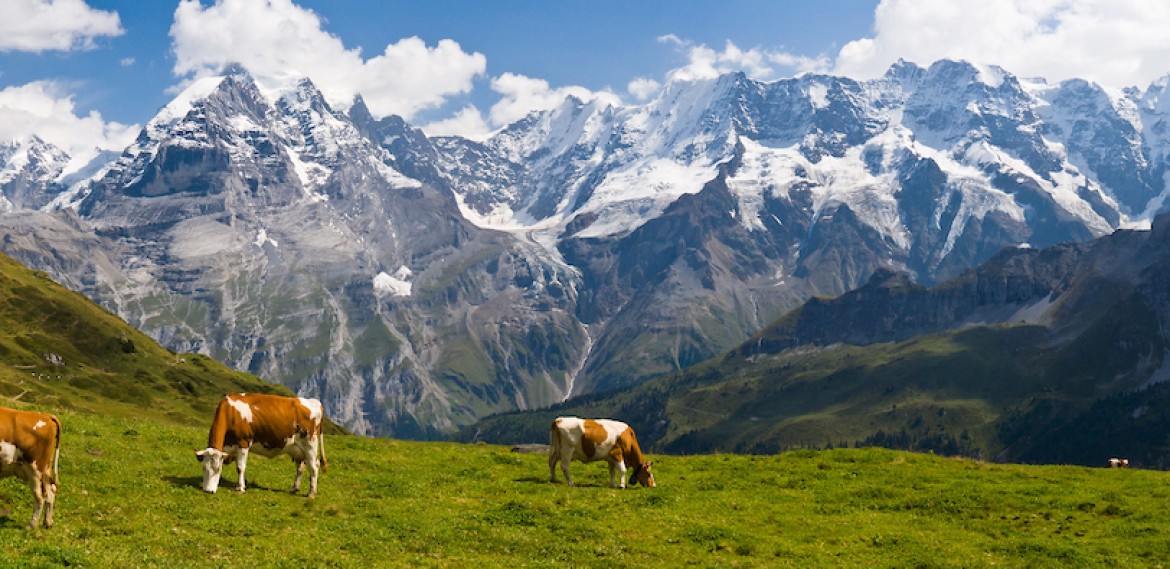
Once at the summit station, follow the familiar yellow signs to the Öeschinensee along a wide trail through meadow and woodland, all the while under the spell of the Blüemlisalp peaks. Finally a narrower trail leads down to the lakeshore. The lake is set at 1578 meters / 5177 feet and has a maximum depth of 56 meters / 184 feet.


The Öeschinensee is fed by a number of surrounding mountain streams, many of which are visible as you walk around the lake. But where does the water go? There’s no visible outlet. The answer is really quite simple: The Öeschinensee drains underground. So while you don’t see it leaving, you can see it as it as it resurfaces in the Oeschibach, which produces electricity and drinking water for Kandersteg.


Once at the lake, take your time to enjoy the setting. You’ll want to walk to the restaurants and hotels at the west end of the Öeschinensee. While you can’t make a full loop around the lake, because of the steep cliffs than plunge directly into the water, you can explore the lakeside pathways for as far as they will take you.


The Öeschinensee is a haven for hikers, and a great starting point for other hikes in the area. You can explore those routes and stay at the Fründen hut with its spectacular setting, and continue east into the Jungfrau region. You can also easily return to the chairlift station for your descent back to Kandersteg make the one hour descent on foot back to Kandersteg, either along the service road or by the various footpaths—either way, it’s a steep descent.

Wednesday, December 21, 2011

Val Roseg

Location: Pontresina, Upper Engadine, Canton Graubünden

Distance: 13km /8.1 miles one way

Duration: 5-7 hours

Blessed with the kind of varied scenery that is sure-fire fodder for postcards and Swiss calendars, Val Roseg is certainly one of the loveliest valleys in the Upper Engadine and on a par with any in Switzerland. Woodland, mountain streams, meadows, towering peaks, and a convergence of glaciers make the valley a year-round attraction. For summer hikers the capstone is an ascent to one of the surrounding ridgelines for unmatched views of the region.

In this hike we’ve chosen an ascent to Fuorcla Surlej, not only because it offers great views, but because it also offers a quick decent by tram, allowing you to make an efficient one-way hike and still take in so much of what Val Roseg has to offer. But once you’re in the Val Roseg you’ll quickly sense what a great base it is for other hikes in all direction.

From the heart of Pontresina, walking in the direction of the railway station, follow the waymarked route in the direction of Val Roseg along a wide graded road (which you’ll recognize as also being a superb cross country ski trail in the winter). The road and adjoining trails gently ascend the valley through lush woods and manage to stay on the valley floor as they parallel and cross the glacial drainage of Ova da Roseg.

Soon the trees give way to meadows and the views from the valley floor open up to reveal the mountains on all sides. The Roseg and Tschierva glaciers appear at the head of the valley and to your left. If you decided to continue in that direction you wouldn’t be the least bit disappointed with a stay at the Coaz hut or the Tschierva hut, both of which offer dramatic and face-to-face encounters with these glaciers. But the route offered here is headed up the slope to the right.

Before you begin your serious elevation gain, stop for a rest—or better yet, lunch and dessert—at the beloved Hotel Roseggletscher. If you’re short on time, or feel content with staying on the valley floor, you could make this the turnaround point for and out-and-back hike. But if you’re still full of energy and infected with a bit of summit fever, then continue on past the hotel in the direction of Fuorcla Surlej.

The trail up the hillside winds through forests and soon breaks through timberline to reveal view of the valley and the glaciers to the southeast. Ascending some rocky slopes on good trails and with a couple stream crossings you’ll reach the glacially-scraped rock of Fuorcla Surlej and the Fuorcla Surlej hut at 2755 meters/9038 feet.

For the descent, continue over the saddle to the wide trail which descends and loops a glacial basin in the direction of the Murtèl tram station (2700 meters/8858 feet), a midmountain stop between the Corvatsch summit station and the base in the town of Surlej. From the Surlej tram station there are frequent busconnections back to St. Moritz and Pontresina.

Monday, December 12, 2011

Meidpass

Location: St. Luc, Val d’Anniviers, Canton Valais

Distance: 10km /6 miles one way

Duration: 5-6 hours

This beautiful pass is a less-frequented alternative on the Haute Route. But since most Haute Route hikers tend to stay higher up in the Val d’Anniviers and cross at the Forcletta Pass, the Meidpass is often overlooked. Too bad—because it’s a more appealing pass in many ways, and offers several scenic lakes and commanding views along the way. This hike can be done as a one way hike from St. Luc to Gruben (in either direction) or as an out-and-back from St. Luc to the Meidsee and returning to St. Luc.

You can begin from the Le Prillet area of St Luc and along the waterfall. Alternatively you can take the quick-start option by taking the funicular from St. Luc to Tignousa, putting you at a starting point right at the treeline.

As you depart the Tignousa funicular station, following the signs pointing south in the direction of the Meidpass, you’ll also taking a virtual tour of the solar system along the Planet Trail, a 6-km long interpretive trail that leads up to the Hotel Weisshorn and has scale models of the planets positioned at correct intervals all along the way. The Planet Trail is a part of the Francois Xavier Bagnoud (FXB)Observatory which you’ll see on the hillside above.

To ascend the Meidpass you can follow the trail leading up th

e hillside to the east behind the Chalet Blanc dairy or continue on the roadway for another kilometer and take a well-marked and more widely-used trail than ascends along a mountain stream. This pleasant ascent soon arrives at the Lac de l’Armina at 2562m/8405 ft. From here the pass—at 2790m/9153 ft, one of the lower and easier Haute Route passes—is just ahead.

At the pass you can drop your French and start speaking German, since the Turtmantal residents to the east are German speaking. At the saddle of the stony pass, with the Meidspitz to the north and the Pigne de Combavert on the south you’ll have views to the west that include Mont Blanc de Chelion, the Grand Combin, and even Mont Blanc in France.

From the pass you have many options, including a return to St. Luc, or descending to theMeidsee below and then on to the seasonal hamlet of Grüben. If you want to prolong your time in the mountains, you might want to consider a stay at the restored Hotel Weisshorn, a Belle Époque treasure with commanding views of the RhôneValley or the Cabane Bella Tola, with a more Spartan standard of accommodation but equally superb views.

Monday, December 5, 2011

Pas de Chèvres

Location: Arolla, Val d’Hèrens, Canton Valais

Distance: 10km /6 miles round trip

Duration: 4-6 hours

The very mention of “the ladders” puts fear into the hearts of some the toughest Haute Route trekkers. Climbing or descending the 90 iron rungs that connect the bucolic Val d’Hèrens with the icy and rocky expanse of the Cheilon Glacier, over the Pas de Chèvres can require a stout heart and nerves of steel—especially if you’re carrying a heavy pack, skis, or if the rungs are wet and icy.

But on a clear and warm summer day it can be a grand adventure and an exhilarating dayhike, complete with Matterhorn views, glacier views, plus a little scrambling and boulder hopping.

Starting from Arolla walk up the narrow winding paved streets to the Grand Hotel Kurhaus. Continue up the marked trail a southwesterly direction to Remointse d’Arolla. Soon you rise through the treeline amid scattered larch and Arolla pines. Continuing up the trail, with the Pigne d’Arolla and the Glacier de Tsdjiore Nouve on your left you’ll maintain a steady ascent.

Following the trail in the direction of both the Col de Riedmatten and the Pas de Chèvres you come to a popular rest stop and fork in the trail at an elevation of 2738m/8982ft with the ridgeline of the Monts Rouge in front of you. The path to the right takes you to the Col de Riedmatten, and the path to the left to the Pas de Chèvres—both passes and routes clearly visible in front of you.

Here the hike becomes a loop. You do the clockwise ascent of the Pas de Chèvres (2855m/9366 ft), descend the ladders then make the boulder-strewn traverse to ascend the Col de Riedmatten (2943m/9622ft) and return back to junction, or do it as a counter-clockwise loop. For my money, I prefer the counter-clockwise version, which has you descending the narrow Col de Riedmatten and climbing the ladders.

Either way, you can expect fine views in all directions from the summit of both passes—views that include the distant Matterhorn, the Weisshorn, Mt Blanc de Cheilon and the Cheilon Glacier. Your return to Arolla will be a steady descent of 937m/3042ft and those trekking poles will be a godsend as they cushion your well-worked knees.


Gornergrat

Location: Zermatt

Distance: 7.5 miles/12 km one way

Duration: 4-5 hours


The late 19th century must have been an exciting era for residents of Zermatt. After the dramatic and fateful first ascent of the Matterhorn in1865, worldwide interest in this alpine hamlet spread quickly. Zermatt was connected to the Morse telegraph network in 1872. Mark Twain arrived in 1878 and wrote his comic story “Climbing the Riffelberg.” The first train arrived in 1891, and just 7 years later in 1898 the Gornergratbahn went into operation, taking visitors into a glacial paradise unlike any other.

Today access to the crest of the Gornergrat (10,134 ft / 3089m) is made by hundreds of thousands of visitors annually on the Gornergratbahn railway, a 29-minute ride on a cog railway with stops at Findelnbach, Riffelalp, Riffelberg, Rotenboden. At the Gornergrat summit, a hotel, restaurants and shopping center await arriving passenger, but the real attraction is the view of the Gorner Glacier and over a dozen 4000 meter peaks.

Hikers in search of a more authentic outdoor experience can hike from Zermatt to the top of the Gornergrat or combine their hike with the train, and take the train up, down, or for any portion of the route. The train is expensive—especially if you purchase a round trip ticket to the top—but it’s enjoyable and immensely entertaining, and well worth purchasing the ticket for the portions of the trip you don’t necessarily want to hike. Hiking the entire distance round trip from Zermatt would be 24km/15 miles and require 1500m/4920 ft. of elevation gain and loss. The primary reward on this hike is the iconic and breathtaking mountain views, so plan this hike for the clearest and best weather day of your stay in Zermatt.

For my money, I prefer taking the train just one way, and also avoiding the ski utility roads and the busiest sections of the trail. For a full day outing, consisting of between 5-8 miles, what follows is a route which does exactly that.

First, board the train Zermatt and enjoy the ascent offering splendid views of the Findeln Gorge and the Matterhorn. Once you pass the station at Riffelalp, you ascend above the treeline, and the views become spectacular. Get off the train at Riffelberg.

From the Riffleberg station take the wide, well marked trail to the south in the direction of Riffelberg. Throughout your ascent you’ll have unobstructed views of the Matterhorn. In about 30 minutes from the station, you arrive at a small unnamed lake that offers wonderful reflective views of the Matterhorn and far less crowded conditions than the Riffelsee, just five minutes up the trail.

Continue on to Riffelsee which also offers great views. From Riffelsee you can walk about 5 minutes up the hill to the north and reboard the train at the Rotenboden station for the Gornergrat. But if you’re up for an adventure and an ascent of another 300m/1000 feet, consider continuing on by foot to the Gornergrat. Rather than taking the well-trodden path that parallels the train, consider taking the trail to the south that parallels the Gorner Glacier and continues eastward in the direction of the Monte Rosa.

This trail keeps a fairly level contour above the glacier. You pass mountaineers returning from their climb of the Monte Rosa and other 4000 meter peaks in the region. You’ll see the high-tech Monte Rosa Hut on the lower flanks of the massif and the trail descends—leaving you wondering if you’re really on the right trail. Finally you come to a junction and the trail begins its switchbacked ascent to the Gornergrat. You arrive at the Gornergrat from the backside to the surprising stares of admiring onlookers who never imagined there was a way up other than the train.

From the summit you can certainly take the train all the way back to Zermatt—you deserve the relaxing ride. But if your legs are ready for a descent, take the train back to the Riffelalp station. From the station cross the tracks that lead onto a steep forest trail, which eventually brings you to farms and scattered homes on the outskirts of Zermatt, then to Winkelmatten and finally into Zermatt proper.

Monday, October 10, 2011

Col de Sorebois

Location: Val d’Anniviers, Valais

Distance: 6 miles/10 km

Duration: 3-4 hours


Of all the spectacular valleys in Valais, I’ve always found the Val d’Anniviers to be the most interesting and worthy of extended exploration. And no single hike unveils the majesty and appeal of this immense valley better than an ascent of the Col de Sorebois as it crosses from one finger of the valley to the other.

This hike is frequently used by trekkers on the Haute Route; however, since it is served by regular bus service on both ends of the hike, it’s also a convenient stand-alone day hike. You can start either in Zinal or Grimentz—both wonderful places to spend a night—and take the bus to the restaurant and bus stop on the eastern side of the dam to begin your hike in an eastward direction.

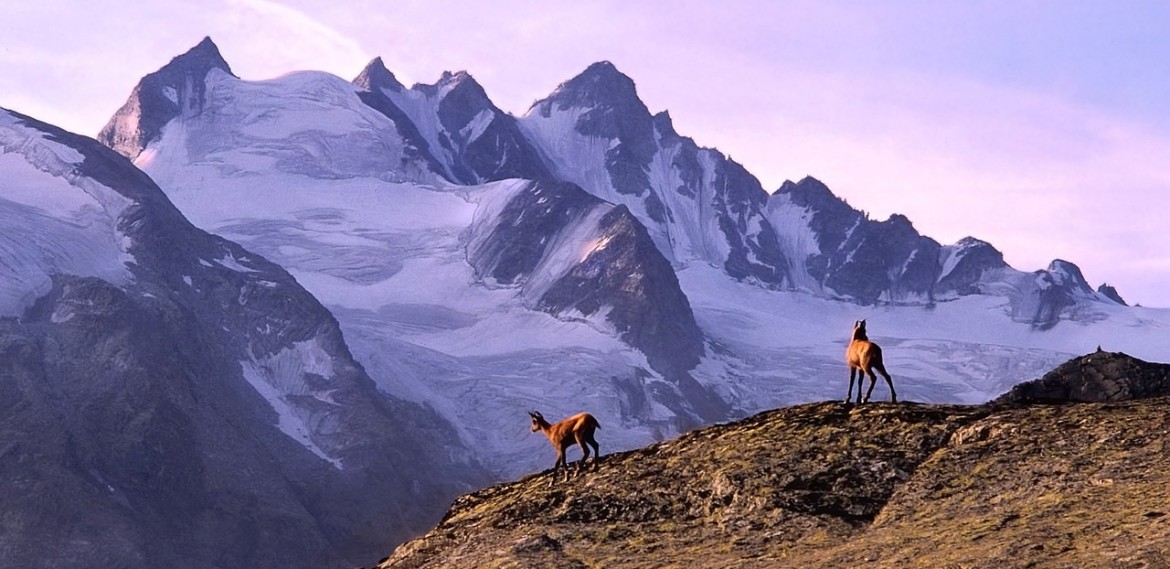
Starting from the dam you’ll have fine views of the Lac de Moiry, but you’ll need to walk or take the bus to the Glacier parking area if you want views of the spectacular Moiry glacier and icefalls. Departing from the dam, follow the well-marked path ascending to the left. As you gain elevation views begin to open up, including Grimentz below and to the north. You’ll also have a good chance of spotting chamois on this less frequented slope.

The most commanding views appear as you reach the saddle in about 1hr 45min. Once at the saddle you can’t resist continuing on to the Corne de Sorebois (2895m), about 5 minutes from the saddle. Here you’ll have panoramic views in all directions . The mountain views are dominated by the Weisshorn, the 4th highest peak in the Alps—higher than the Matterhorn.

The descent drops immediately onto ski utility roads and into the Sorebois ski area. Once at the tram station you have the option of walking to Zinal, taking the tram down, or taking a fat-tire scooter all the way down to Zinal. The scooter is usually less expensive than the tram, and a great way to add a little adventure to the conclusion of your hike.